Back to Basics... Again
I have watched four waves of curricular narrowing in fifty years. The fifth is now in front of us. Here is what the pattern reveals, and what the slogan is built to conceal.


In December 2024, the Indiana State Board of Education approved a redesign of the state’s high school diploma. The new framework, built around three “readiness seals” for enrollment, employment, or enlistment, takes effect with the Class of 2029. Among the changes: fine arts no longer appear among the base diploma’s directed electives. World languages don’t either. The redesign was driven, in the explicit framing of state officials and the governor, by alignment with the workforce.[1]
It is tempting to read this moment as a crisis. New. Unprecedented. The breaking point.
It is none of those things.
After five decades in this field, I can tell you the Indiana decision is not the first time I have seen this move. It is the latest expression of a recurring American pattern. The fifth time in living memory that public education has lurched toward a narrowed definition of “the basics.” I came into this field during the second of those waves. I have watched the third and fourth play out from inside the institutions that fought them.
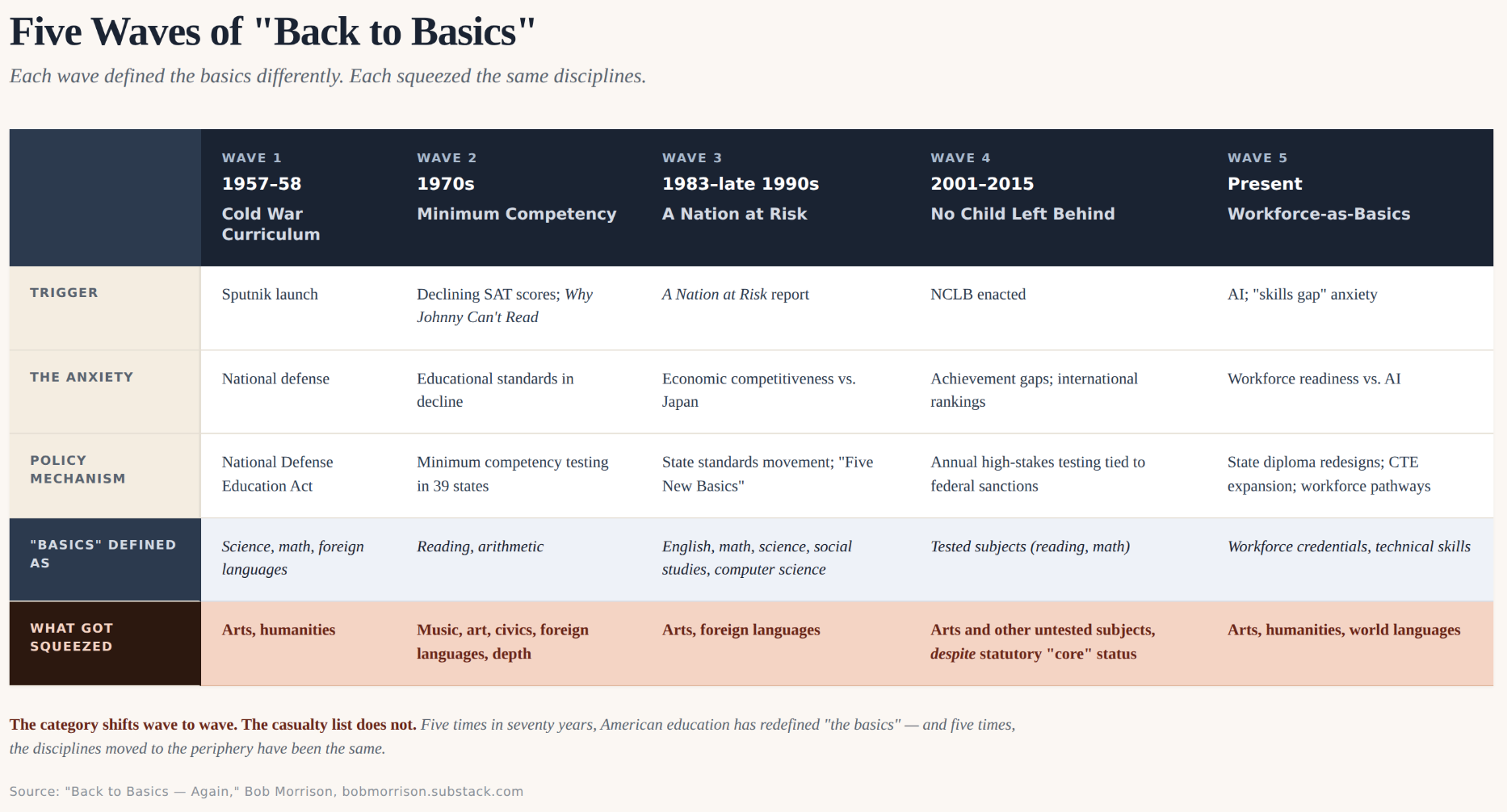
The pattern is the point. Each wave has its own anxiety, its own policy mechanism, its own roster of disciplines that count. Each follows the same shape. Each leaves the same casualty list. And each, set alongside the others, reveals what the slogan “back to basics” is built to obscure: the basics are not a thing one returns to. They are a category that gets constructed, again and again, in the image of whatever the moment is afraid of.
Let me walk you through the five waves. Then the question they all evade.
The First Wave: Sputnik and the Cold War Curriculum
October 1957. The Soviet Union launches a 184-pound metal sphere into orbit. The political reaction is immediate. The educational reaction is swift. Within eleven months, Congress passed the National Defense Education Act (NDEA), which President Eisenhower signed on September 2, 1958.[2]
The NDEA is clear about what counts. Title III provides federal funds for “the strengthening of science, mathematics, and modern foreign language instruction.” Title V supports guidance counselors who can identify scientifically gifted students. Title VI funds language and area studies.
The arts are not in the bill. The humanities, broadly construed, are not in the bill. The legislation takes its name from “national defense” and means the words seriously: education is being redefined as a strategic asset, and the disciplines that matter are the ones that produce engineers, physicists, and Russian-speaking analysts.
The cultural Cold War runs in parallel, with the State Department exporting jazz musicians and the eventual establishment of the National Endowment for the Arts in 1965, but those efforts never fuse with the K–12 curriculum reform triggered by Sputnik. Federal money flows to where the anxiety points. What does not get federal investment does not get strengthened. What does not get strengthened gets slowly reframed, in the implicit logic of the era, as ancillary.
This is the first time in the postwar period that the federal government has formally chosen which disciplines count as foundational to the national interest.
It chooses narrowly. The frame holds.
The Second Wave: Minimum Competency and the Birth of a Slogan
The 1970s. The trigger this time is different, declining SAT scores, disorientation following the educational experimentalism of the 1960s, the recurring cultural panic captured in book titles like Why Johnny Can’t Read (Rudolf Flesch’s bestseller, originally published in 1955 and steadily reprinted into the 1970s).[3] But the move is familiar: define the basics, and tighten the screws on whatever falls outside.
The mechanism is minimum competency testing. Florida moves first, requiring an exam for high school graduation. Other Southern states follow, then a wave of others. From 1975 through 1982, thirty-nine states enacted some form of minimum competency testing program.[4]
The phrase “back to basics” enters American education’s vocabulary not as a description but as a slogan, a shorthand that means, when one looks at what is actually being tested, reading and arithmetic. Sometimes a touch of writing. Often nothing else.
The squeeze is implicit. Schools facing testing requirements in two subjects rationally allocate time toward those two subjects. Time is finite. Music, art, theater, foreign languages, civics, science taught with depth rather than breadth, all of these become, in instructional reality if not in formal designation, the residual category. What is tested is taught. What is not tested becomes negotiable.
This wave is rarely remembered as a curricular narrowing. It is remembered, when it is remembered, as a response to declining standards. But its long effect was to install in American education a habit of mind: the basics are what the test measures.
Once that habit is installed, the next wave has only to expand the testing.
The Third Wave: A Nation at Risk and the Strategic Use of Standards
April 1983. The National Commission on Excellence in Education publishes A Nation at Risk. The report’s most quoted line remains its diagnosis:
“If an unfriendly foreign power had attempted to impose on America the mediocre educational performance that exists today, we might well have viewed it as an act of war.”[5]
The frame is again national-strategic, but the anxiety has shifted from defense to economics. Japan, not the Soviet Union, is the comparator. The threat is not missiles but trade.
The Commission’s recommendations were specific. It named the “Five New Basics”: four years of English, three years of mathematics, three years of science, three years of social studies, and a half-year of computer science.[5] The arts were not in the list. Through the late 1980s, states adopted graduation requirements that mirrored the New Basics framing. Standards work began across content areas, with the National Council of Teachers of Mathematics releasing the first national content-area standards in 1989.[6]
Then came Charlottesville.
In September 1989, President George H.W. Bush and the National Governors Association convened an education summit at the University of Virginia, with Governor Bill Clinton of Arkansas leading the governors' delegation as NGA chair. The product was the National Education Goals — the framework that would shape American education policy for the next decade. Goal Three named the “core subjects” in which all students would demonstrate competency: English, mathematics, science, history, and geography.[7]
Music and the arts were not listed.
That omission was the catalyst for everything that followed.
What it produced was not pushback in the conventional sense. It was something sharper. Working through institutions led by John Mahlmann at the Music Educators National Conference, Karl Bruhn and Larry Linkin at the National Association of Music Merchants, Mike Greene at the Recording Academy, and myself with the American Music Conference, the arts education community made a strategic decision: rather than fight the standards movement from the outside, they would use it. The standards framework was the language of policy legitimacy in that decade. The arts would write their own.
The National Commission for Music Education was assembled in 1990. Its 1991 report, Growing Up Complete: The Imperative for Music Education, led to the founding of the National Coalition for Music Education. The strategic premise was clear: the arts would secure their place in the federal curriculum by producing what the other disciplines were producing — rigorous, discipline-specific national standards in the language of the standards movement itself.
The rallying moment came in November 1991, when Secretary of Education Lamar Alexander, in a letter to MENC, described music and arts education as “extracurricular.” For advocates, this was the last straw. On February 25, 1992, NARAS CEO Mike Greene used the Grammy Awards broadcast, watched globally by an estimated 1.5 billion viewers, to call out the omission of the arts from America 2000. Ten days later, Alexander’s office announced the creation of the “America 2000 Arts Partnership.”[8] In February 1993, the new Secretary of Education, Richard Riley, released a formal statement affirming the arts as “a vital part” of American education.
The institutional victory followed. On March 31, 1994, President Clinton signed the Goals 2000: Educate America Act, which formally added the arts to the National Education Goals’ enumerated core subject areas, the first time U.S. law identified the arts as a core component of the K–12 curriculum.[9] In April of the same year, the Consortium of National Arts Education Associations released the National Standards for Arts Education, the second content area to publish national standards, after mathematics in 1989.[10] Through the late 1990s, nearly every state adopted arts standards of its own. Research efforts built an empirical base, including music and its impact on child development, the founding of the Arts Education Partnership in 1995, and the Champions of Change report in 1999. Philanthropy surged in parallel — Mr. Holland’s Opus in 1996, VH1 Save The Music in 1997, expanded school programs from the GRAMMY Foundation and others.
The strategic appropriation worked. The standards framework, used against the arts in the 1980s, became the vehicle for the arts’ formal recognition. By every visible institutional measure, the arts had won inclusion.
The wave appeared to have broken in their favor.
It had not. The next wave was already forming.
The Fourth Wave: No Child Left Behind and the Hollowing of Inclusion
January 2002. President George W. Bush signs the No Child Left Behind Act. The mechanism this time is different from anything that has come before: not a curriculum framework, not a slogan, not a set of graduation requirements. NCLB establishes a national accountability regime based on annual high-stakes testing in reading and mathematics. Schools whose tested students do not improve face escalating federal sanctions: identification, restructuring, takeover.
NCLB did not repeal the arts’ core academic status. It preserved the designation, listing the arts among ten core academic subjects, language carried directly forward from the 1990s arts inclusion victory. The Every Student Succeeds Act of 2015 would later broaden this to “well-rounded education,” explicitly enumerating music and the arts.[11]
The statutes held.
The testing apparatus did not.
The map of what got tested became, in practice, the map of what got taught. Schools facing federal sanction reallocated time, staffing, and budget toward the tested subjects. Untested subjects, including the arts, that the law itself named as core, became the line items principals adjusted when accountability pressure mounted. The 1994 National Standards for Arts Education remained on the books in nearly every state. The instructional minutes, the arts specialist positions, the rehearsal-room budgets moved elsewhere.
By 2007, the data was clear. A Center on Education Policy survey of 349 school districts found that 62% had increased instructional time for English language arts and mathematics since NCLB took effect. To do so, 44% had cut time from other subjects. The cuts were not evenly distributed: among districts that reduced time for art and music specifically, the average reduction was 57 minutes per week — a 35% loss of elementary instructional time in those disciplines. The pattern was sharpest in districts with schools identified as "needing improvement" under NCLB: 30% of those districts had cut time from art and music.[12]
By the early 2010s, federal pressure on tested subjects had crystallized into something more durable than testing alone. The Common Core State Standards Initiative, launched in 2009 by the National Governors Association and the Council of Chief State School Officers, produced national standards in only two subjects: English language arts and mathematics. The federal government — through Race to the Top grants and ESEA flexibility waivers — incentivized rapid adoption. Forty-five states and the District of Columbia adopted Common Core within four years.[13]
By elevating two subjects to a national framework while leaving the arts at state standards developed two decades earlier, Common Core deepened the hierarchy NCLB had built. The political backlash was severe. Conservative critics attacked the initiative as federal overreach; by 2016, several states had withdrawn or rebranded their standards. But the backlash did not roll back the curricular narrowing Common Core had cemented. It only changed the political vocabulary in which the next wave would be argued.
The wave ran for nearly twenty years. It captured both political parties. And it revealed what the prior waves only suggested: it is possible to win on paper and lose in practice. The 1990s arts coalition had done the legislative and institutional work. The strategic appropriation of the standards movement had succeeded. NCLB-era implementation rendered that success, in too many districts, hollow.
The lesson is plain. Naming the arts as foundational is necessary but not sufficient. Implementation reveals the actual hierarchy.
The Fifth Wave: Workforce-as-Basics
The present. The current wave is workforce-driven. The anxiety has shifted again, automation, artificial intelligence, the “skills gap,” and global competitiveness rebooted for a digital era. The policy mechanism is no longer a single federal law but a distributed pattern: state-level diploma redesigns, expansion of Career and Technical Education, “future ready” rebrandings, employer-aligned graduation requirements, and work-based learning mandates. Even the US Department of Education got in on the act, focusing on only four subjects and calling arts education “a distraction.”
The Indiana redesign described above is one of dozens. In 2024 alone, states committed more than $105 million in new funding to college-and-career pathways tied to workforce readiness.[13]
What gets defined as basic in this wave is what policymakers claim employers need. The metric of educational value becomes economic utility, measured in the short term. Disciplines that do not produce immediately legible labor-market outcomes become, in policy framing, optional, sometimes warmly endorsed in rhetoric, but structurally moved to the periphery of the requirement architecture.
There is a complication worth highlighting. When employers themselves report their actual hiring needs, through the World Economic Forum’s Future of Jobs Report 2025, through McKinsey’s January 2026 reversal on liberal arts hiring, they describe creativity, adaptive judgment, and the capacity for original thinking under uncertainty as their top unmet demands.[14] The workforce-readiness movement is narrowing the curriculum in the name of employer demand at exactly the moment that demand is shifting away from the narrowing. The fifth wave is built on a definition of “workforce ready” that the workforce itself has begun to publicly repudiate.
The Indiana case is instructive precisely because it is not extreme. After significant public protest, Indiana’s Secretary of Education Katie Jenner emphasized that fine arts had not been required even under the previous Core 40 diploma, a true statement that does not address the deeper change. The previous architecture made arts a directed elective alongside world languages and CTE, signaling their place in a serious academic preparation. The new architecture replaces that signal with twelve “personalized electives” oriented toward seal pathways, two of which are explicitly workforce-keyed.[15]
The disciplines have not been banned. They have been moved.
This is the recurring pattern. Each wave uses the language of common sense, basics, accountability, and readiness to relocate certain disciplines from the foundation to the optional layer. None of the waves calls this a curricular philosophy.
All of them are.
Whose Basics?
It is worth pausing here to ask a question the slogan “back to basics” is constructed to forbid.
Whose basics? Against what baseline?
The Sputnik wave defined basics as what served national defense. The minimum competency wave defined basics as what could be measured on a state exam. The Nation at Risk wave defined the "New Basics" of an economy under threat from Japan. The NCLB wave defined basics as what stood between a school and federal sanctions. The current wave defines basics as what policymakers say employers need from a high school graduate, even as the employers themselves describe something different.
These are not the same definition. They are not even compatible definitions. Each was generated under specific political pressure, in response to a specific anxiety, and each was presented to the public as a return to something, as if there had once been a stable agreement, somewhere in the past, about what the basics were, and the moment’s work was simply to recover it.
There was, and is, no such agreement.
There has never been a moment in American educational history when “the basics” denoted a fixed set of disciplines outside the political conditions that defined them. The phrase is always a construction. It is always defined by what it excludes.
This is not an indictment of any one wave. It is an observation about the category. To debate which subjects are basic is already to accept the framing. The more interesting question, the question this series takes up, is what serious civilizations have actually treated as foundational to the education of the young, across centuries, across continents, across political and economic forms wildly unlike our own.
What the Real Basics Actually Are
Every wave of “back to basics” has been a return to a recently constructed past. Sputnik wanted the basics of 1955. The minimum competency movement wanted the basics of some imagined prewar classroom. A Nation at Risk wanted a Cold War rigor that had never quite existed. NCLB wanted the basics of what could be measured on a bubble sheet. The current wave wants the workforce of an economy whose time has passed.
None of these is actually going back. They are arguments about the recent past, dressed in the language of permanence.
If we are going to take the slogan seriously, if we are going to actually go back to basics, then the question is not which mid-century curriculum to recover. The question is what serious civilizations have treated as foundational across the entire arc of recorded history. Not for fifty years. Not for two hundred. For five thousand.
That record exists. It is long, well-documented, and remarkably consistent across cultures that had nothing else in common. And it disrupts almost every familiar nostalgia about what education used to be.
Pick the era. The American Founders. The 1950s before Sputnik. The medieval university. Fifth-century Athens. The schools of pharaonic Egypt or Sumerian Uruk. In every one of those eras, across language, religion, political form, economic structure, music and the arts were not extracurricular. They were not enrichment. They were not negotiable. They were, in formal curricular structure and in the philosophical writings that justified those structures, foundational.
This series, The Founding Disciplines, will substantiate that claim. Four previews of what is coming.
Ancient Greece. The Greek term mousike did not mean what “music” means today. It encompassed music, poetry, and dance, a unified domain of formation. Mousike and gymnastics were the two halves of Greek education itself. Plato’s Republic devotes substantial portions of Books II and III to musical education. Aristotle’s Politics devotes Book VIII to it. Both treat music as constitutive of the formation of citizens. Not ornamental. Constitutive.
The medieval university. When the European university crystallized in the eleventh and twelfth centuries, its curriculum was the seven liberal arts, structured into the trivium (grammar, logic, rhetoric) and the quadrivium (arithmetic, geometry, music, astronomy). Music was one of the four mathematical sciences. To be educated, by the architecture of the university itself, was to know music. The Islamic scholarly tradition, contemporaneous and parallel, ran the same architecture, with figures like al-Farabi producing comprehensive mathematical treatises on music that would shape both traditions.
Reformation Germany. Martin Luther placed music second only to theology among human disciplines. The Lutheran town schools of sixteenth-century Germany required every child to learn music. Two centuries before American public schools existed, communities across Protestant Europe had already built music into the institutional fabric of universal education.
Boston, 1838. When music entered the curriculum of the American common school under Lowell Mason, it was not added to an existing structure. It was part of the founding architecture of American public education itself.
These are not hand-picked exceptions. They are representative. This series will work through them in detail, including the schools of Sumer and Egypt, the Confucian Six Arts, the Vedic curriculum, the Roman Quintilian, and the long institutional history that delivers music into the American common school and, from there, into the modern profession.
So yes. Let’s go “back to basics.”
All the way back.
And what will we find when we do?
There has never been a serious civilization that treated music and the arts as disposable. The record is 5,000 years old, and it is unbroken.
The next wave of education reform will be built by someone. The question is whether it will be built on a fifty-year selective memory, or on what the actual record of human civilization shows.
Next: Article II of The Founding Disciplines: The Founding Claim: Music as Original Curriculum.
Sources and Further Reading
The data, statutes, and historical claims in this article draw on the following primary sources. Readers who want to go deeper on any section will find these the most useful starting points.
1. New Indiana Diploma approved by the Indiana State Board of Education, December 11, 2024, with implementation for the Class of 2029 and optional adoption beginning in 2025–26. The previous Core 40 diploma’s directed electives, which included world languages, fine arts, and career and technical education, are replaced by twelve “personalized electives” oriented toward enrollment, employment, or enlistment readiness seals. Indiana Department of Education materials and contemporaneous coverage in Indiana Capital Chronicle and Chalkbeat Indiana, December 11, 2024.
2. National Defense Education Act of 1958, P.L. 85-864. Title III: “Financial Assistance for Strengthening Science, Mathematics, and Modern Foreign Language Instruction.” Available via the U.S. Government Publishing Office (GovInfo).
3. Rudolf Flesch, Why Johnny Can’t Read—And What You Can Do About It (New York: Harper & Brothers, 1955), reissued and reprinted across the 1960s and 1970s as a recurring touchstone for declining-literacy panics.
4. “Student Performance Standards and Testing,” ERIC ED252530, p. 14. See also John L. Rury, Ryan Belew, and Jennifer Hurst, “The Origins of American Test-Based Educational Accountability and Controversies About Its Impact, 1970–1983,” Teachers College Record (2022), tracing the movement’s origin in Florida and its diffusion through Southern and other states.
5. National Commission on Excellence in Education, A Nation at Risk: The Imperative for Educational Reform (Washington, DC: U.S. Department of Education, April 1983). The “Five New Basics” recommendation appears in the report’s section on Content. Full text available via ERIC ED226006 and the Internet Archive.
6. National Council of Teachers of Mathematics, Curriculum and Evaluation Standards for School Mathematics (Reston, VA: NCTM, 1989) — the first national content-area standards published in the United States.
7. 1989 Education Summit, held September 27–28, 1989 at the University of Virginia, Charlottesville. The summit was convened by President George H.W. Bush, with Governor Bill Clinton of Arkansas leading the governors' delegation in his role as chair of the National Governors Association. The summit produced the framework that became the National Education Goals, formally announced by the NGA in February 1990. Goal Three named English, mathematics, science, history, and geography as the core subjects in which all students would demonstrate competency; the arts were not included.
8. For a comprehensive account of the November 1991 Alexander letter, the February 1992 Grammy Awards address by Mike Greene, the Maryville (Tennessee) protest concert, and the announcement of the America 2000 Arts Partnership, see Bob Morrison, “The Untold Story of How Music and Arts Education Became Core Subjects,” bobmorrison.substack.com, March 2025.
9. Goals 2000: Educate America Act, P.L. 103-227, signed March 31, 1994. The Act formally added the arts to the National Education Goals’ enumerated core subject areas, alongside English, mathematics, science, foreign languages, civics and government, economics, history, and geography. Available via Congress.gov (H.R. 1804) and GovInfo.
10. Consortium of National Arts Education Associations, National Standards for Arts Education: What Every Young American Should Know and Be Able To Do in the Arts (Reston, VA: Music Educators National Conference, 1994). The standards covered dance, music, theater, and visual arts. They were the second national content-area standards published, following the National Council of Teachers of Mathematics’ standards of 1989. Available via ERIC ED365622.
11. No Child Left Behind Act of 2001, P.L. 107-110, listing the arts among ten "core academic subjects" (Title IX, §9101); Every Student Succeeds Act of 2015, P.L. 114-95, replacing that language with "well-rounded education" and explicitly enumerating music and the arts. Both available via Congress.gov.
12. Jennifer McMurrer, Choices, Changes, and Challenges: Curriculum and Instruction in the NCLB Era (Washington, DC: Center on Education Policy, July 2007); follow-up analysis in Instructional Time in Elementary Schools: A Closer Look at Changes for Specific Subjects (Center on Education Policy, February 2008). Findings drawn from a nationally representative survey of 349 school districts conducted November 2006 – February 2007.
13. Common Core State Standards Initiative, launched in 2009 under the joint sponsorship of the National Governors Association Center for Best Practices and the Council of Chief State School Officers. By 2014, 45 states and the District of Columbia had adopted the standards. Federal incentives included the U.S. Department of Education's Race to the Top competitive grant program ($4.35 billion in initial funding, with state adoption of "college- and career-ready standards" as a scoring criterion) and ESEA flexibility waivers granted under the Obama administration's NCLB waiver authority.
14. ExcelinEd, “7 Education Policy Trends for State Lawmakers in 2025,” December 2024.
15. World Economic Forum, Future of Jobs Report 2025, ranking creative thinking, resilience, curiosity, and lifelong learning among the top skills employers identify for the workforce through 2030. McKinsey & Company CEO Bob Sternfels, in a January 2026 Harvard Business Review IdeaCast interview reported by Fortune (January 14, 2026), announced the firm’s reversal on hiring priorities, actively recruiting graduates capable of “discontinuous leaps” in thinking that AI cannot replicate, with creativity, aspiration, and judgment named as the firm’s most-needed capacities.
16. Indiana Secretary of Education Katie Jenner, remarks at Indiana State Board of Education meeting, December 11, 2024, encouraging local districts to “consider locally-created pathways for those students who are interested in the arts.”