
I’ve spent five decades telling anyone who would listen that arts education isn’t an extra. It belongs to what schools do, not to what schools do when there’s time and money left over. I’ve founded organizations, worked in policy rooms and classrooms, written, and testified. And in all that time, one thing I’ve always wanted more of is data. Solid, longitudinal, student-level data. The kind that lets us stop saying “we know this works” and start saying “here is exactly what we saw.”
Last spring, the Rhode Island State Council on the Arts asked our team at Quadrant Research to look. Rhode Island’s Department of Education (RIDE) had made student-level records available through the state’s Longitudinal Data System, eight years of them, covering school years 2017-2018 through 2024-2025. The question was straightforward: do Rhode Island students who take arts courses have lower chronic absenteeism than students who don’t?
The answer is more interesting than a simple yes.
This wasn’t our first look at the question. Quadrant ran a similar analysis in Virginia in 2024 and found that seniors with four years of arts instruction had chronic absenteeism rates roughly 34 percent lower than their peers. Rhode Island gave us a chance to extend that earlier work: more years of data, sustained-participation cohorts across three grade bands, discipline-specific analysis for music, and formal statistical controls for demographic and district-level differences.
Context
Chronic absenteeism, defined in Rhode Island as missing at least 10 percent of the school year (roughly 18 days), is not a small problem. About one in three Rhode Island seniors was chronically absent in the 2024-2025 school year. Missing that much school is associated with lower academic performance, higher dropout risk, and worse college and career outcomes. The pandemic drove these numbers sharply higher, and while Rhode Island has recovered somewhat, absenteeism sits well above where it was in 2018.
Every state I work with — and I work with 32 of them through the Arts Education Data Project — is asking the same question: what actually gets kids back to school?
What we found
Casual arts enrollment at the high school level doesn’t move the needle much. In recent years, Rhode Island high school students who took an arts course or two were chronically absent at roughly the same rate as students who took none. That surprised me at first. It shouldn’t have. One class in one year is not the same as sustained engagement.
What moved the needle was sustained participation across multiple years. And students who sustained music participation specifically told the strongest story of all.
Rhode Island seniors who took a music class in every year of high school, a cohort our report calls “Career Music” seniors, had chronic absenteeism rates 34.5 to 59.3 percent lower than their peers without sustained music participation. This wasn’t a one-year anomaly. It held in every senior class we studied, from 2021 through 2025. On average, Career Music seniors were chronically absent at rates 45 percent lower than their peers.
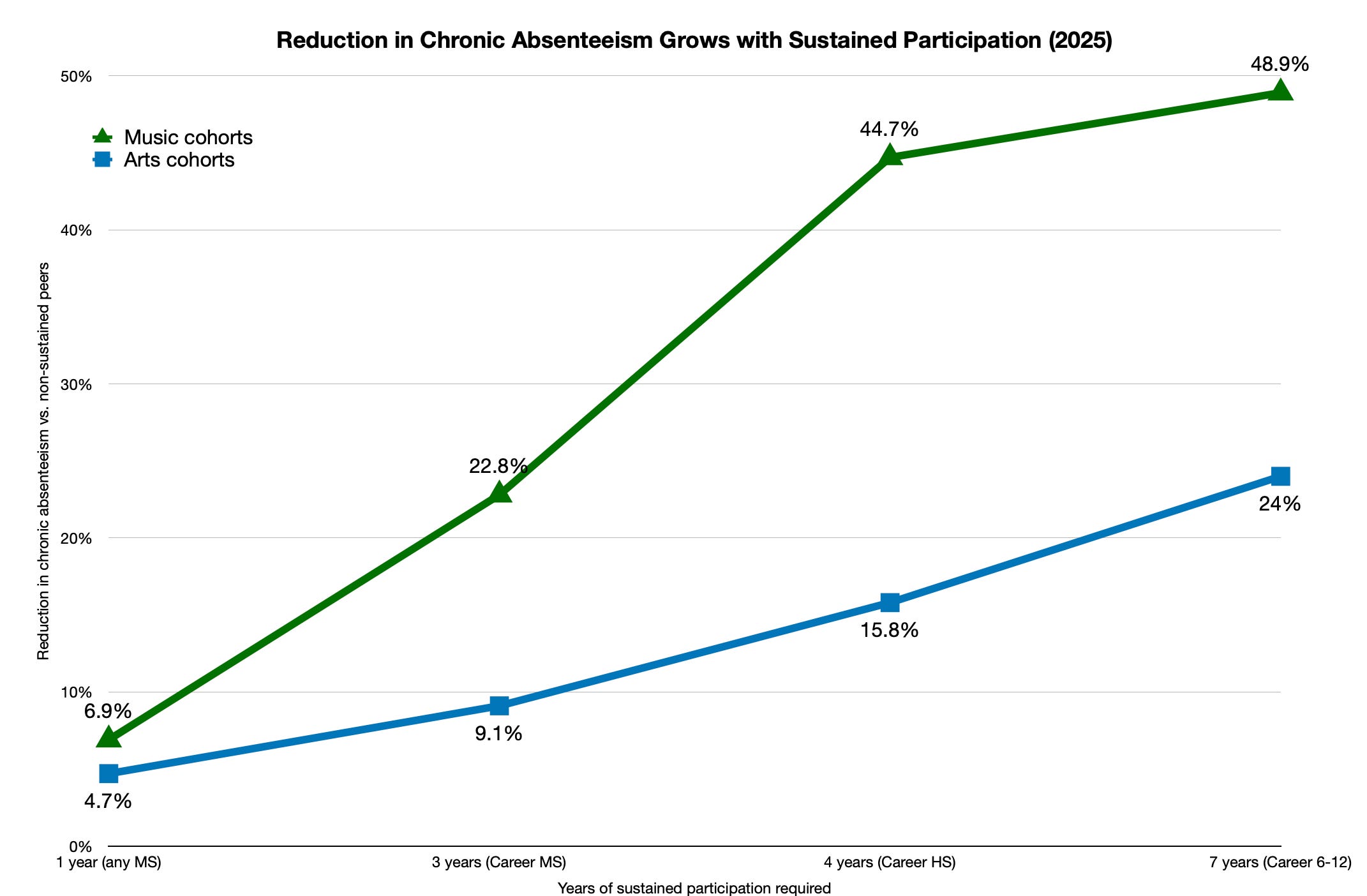
And it strengthens with dose. Look at the pattern:
One year of any middle school music: 7 percent lower chronic absenteeism than peers
Three consecutive years of middle school music: 23 percent lower
Four consecutive years of high school music: 45 percent lower
Seven consecutive years, from grade 6 through grade 12: 49 percent lower
That’s a monotonic dose-response pattern. The longer students stayed engaged, the larger the gap.
Who benefits most
Here’s the part that matters most to me. When we broke the sustained-arts cohort down by demographic subgroup, the largest chronic absenteeism advantages showed up in the groups facing the highest baseline rates: Black students, Hispanic students, and multiracial students. In the 2025 senior class, Black students who sustained four years of arts participation had chronic absenteeism rates 25 percent lower than their peers. For multiracial students, 19 percent lower.
These are the students most at risk of falling behind through absence. They are also the students for whom sustained arts participation shows the largest observed advantage.
That’s not something to shrug off.
What this proves — and what it doesn’t
I want to be careful here. This is a correlational study, not a randomized experiment. Students who choose to take music every year of high school are almost certainly different from students who don’t — in ways involving family support, prior academic engagement, motivation, school culture, and other factors we can’t fully see in the data.
We ran the numbers hard. We applied progressive statistical controls for what we could observe: demographics, year of study, and school district. The sustained-music finding survived those controls with only modest attenuation. The Career Arts finding at the senior level attenuates more substantially but remains statistically significant. The Career MS Arts finding — three consecutive years of middle school arts — doesn’t survive adjustment, which is worth pointing out clearly. Whatever advantage that group shows is fully explained by who is choosing to enroll and where they attend school, not by the participation itself.
We cannot claim causation from observational data. What we can say is this: across eight years of Rhode Island student-level records, the most consistent and adjustment-robust signal we found for lower chronic absenteeism was sustained arts participation, with music the strongest effect within it.
What this means
If you’re looking for a lever to pull on chronic absenteeism — and every state is — sustained arts participation warrants serious attention. Not as a magic solution, but as one component of a broader strategy that also includes family engagement, mental health supports, transportation, and everything else we already know matters.
What sustained arts participation offers that is somewhat different from other levers: it works over time, with the same students, at the schools they already attend. It doesn’t require a new program. It requires that the arts programs students are already in be protected and expanded, that opportunities exist across four years, not just one, and that access is equitable across every district and every community.
What comes next
Rhode Island is one state. Virginia is another. We’re already working on similar analyses in additional states through the Arts Education Data Project. Every additional state we bring into the data conversation strengthens what we can say about the pattern and where it does or doesn’t hold.
Here’s my ask. Arts education needs to be part of every state’s chronic absenteeism strategy. Not as an afterthought or an add-on. As one of the levers we know shows up in the data. If you sit on a school board, ask what sustained multi-year arts opportunities look like in your district: not just which arts courses exist, but whether students can string them together. If you’re a state education leader, ask whether your absenteeism plan includes protecting and growing arts programs. If you’re an advocate, a parent, or a foundation program officer, push for arts education to be treated as what it is: part of how schools keep kids showing up.
The finding here is not a magic solution. It is a signal, one of the most consistent I’ve seen, and it’s up to all of us to act on it.
The press release with quotes from the Governor, Commissioner of Education, and Executive Director of the Rhode Island Council on the Arts is available here
The full report, prepared for the Rhode Island State Council on the Arts, is available here.
Does your research drill into *which* music ensembles? I ask because choral programs can be less expensive than instrumental programs, which should make them more attractive to administrators’ budgets. And is there parallel sports engagement research? Is it engagement that values each students’ contribution to the whole? (Here a possible sports parallel fails, since a 3rd-string player likely gets less playing time, whereas every member of a music ensemble participates.)
Do you have this article in PDF so I can send to my admin, thank you very much!!
Our district is implementing a push to improve attendance this year.